Equipment
- electronic balance
- steel wool
- 9 volt battery
- butane gas lighter.
- Evaporating dish to secure the steel wool on the scale.
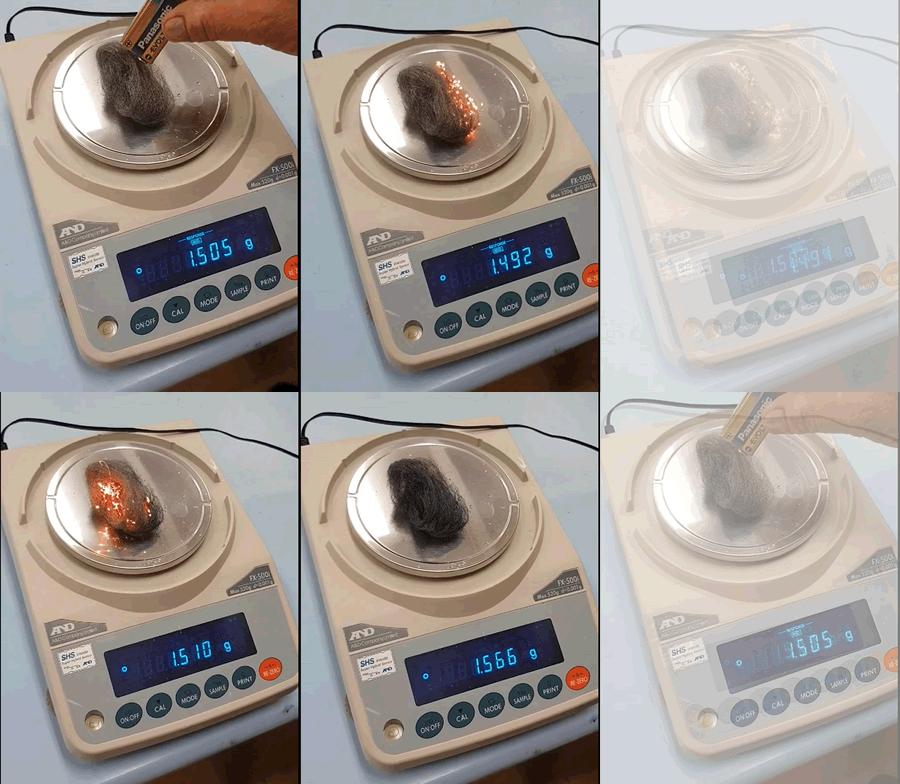
If the battery is flat and will not ignite the steel then a butane gas lighter can be used. In fact, a propane gas lighter is more efficient in burning the entire steel sample. Ideally you should protect the scale by placing the steel wool in an evaporating dish before igniting.
Step 1 Weigh approximately 1.500 grams of steel wool.

Step 2 Ignite the steel by touching the electrodes of a 9-volt battery to the steel wool.


Step 4 When the reaction is complete read the mass from the scale.

1) Calculate the mol of iron present initially.
2) Calculate the mass of oxygen that reacted.
3) Calculate the mol of oxygen that reacted.
4) Find the empirical formula of the iron oxide formed.
5) What two assumptions are made in calculating the empirical formula.
Solution
6) How can you increase the reliability (repeatablitiy) of your data?
7) How can you compare the accuracy of your results?
8) Is your conclusion valid?

Definitions and examples of validity, accuracy and reliability are given below.
Validity relates to the experimental method. A method is valid if:
• it actually tests the hypothesis with an appropriate range of values of the independent variable.
• suitable equipment is used (e.g. a pipette is used to measure an accurate volume rather than a beaker)
• variables, other than the dependent and independent, are controlled
• assumptions are satisfied
Reliability (repeatability) relates to the ability of the experiment when repeated to derive similar results . An experiment is reliable if it can be repeated to obtain consistent results within an acceptable range. Reliability is improved if the experiment is repeated many times and the results averaged. Repetition minimises the impact of random errors on the results and identifies outliers which can be discarded. A discussion on reliability should include mention of any random errors that have been identified. Random errors reduce reliability.
Accuracy depends on both reliability and validity and describes how close a measured result is to the true or accepted value. Results are considered accurate when they agree with values reported in the literature or supported by secondary studies. Accuracy can be improved through good experimental design, such as using appropriate measuring equipment and implementing methods to minimise systematic errors. Systematic errors shift results away from the true value and therefore reduce accuracy.